Do I Have to Take Lab Portion Again Ucr
Welcome
Welcome to the laboratory of Maria Ninova, Assistant Professor at the Department of Biochemistry, University of California, Riverside. The lab opened on July 1st 2021 and is actively recruiting curiosity-driven and motivated team members interested in epigenetic regulation, pocket-sized not-coding RNAs, and transposon control in germ cells and animate being development at different career levels, including technicians, undergraduate, graduate, and postdoctoral researchers - click here for more than details!
Research
An organism's genome contains all the information necessary for its development and role, including genes that encode RNA and poly peptide molecules, regulatory regions that coordinate gene activity to form dissimilar cells and answer to stimuli, structural regions responsible for the stability, organization and true-blue DNA transmission during cell sectionalisation, as well as "parasitic" elements and regions of no or unknown office. It is essential that this information is organized and switched on and off in a controlled manner, such that only pieces relevant to a specific cell type and function are active at a given time. I of the most of import means of genome regulation in eukaryotes is through the association of DNA with histone proteins into a college lodge chromatin structure. 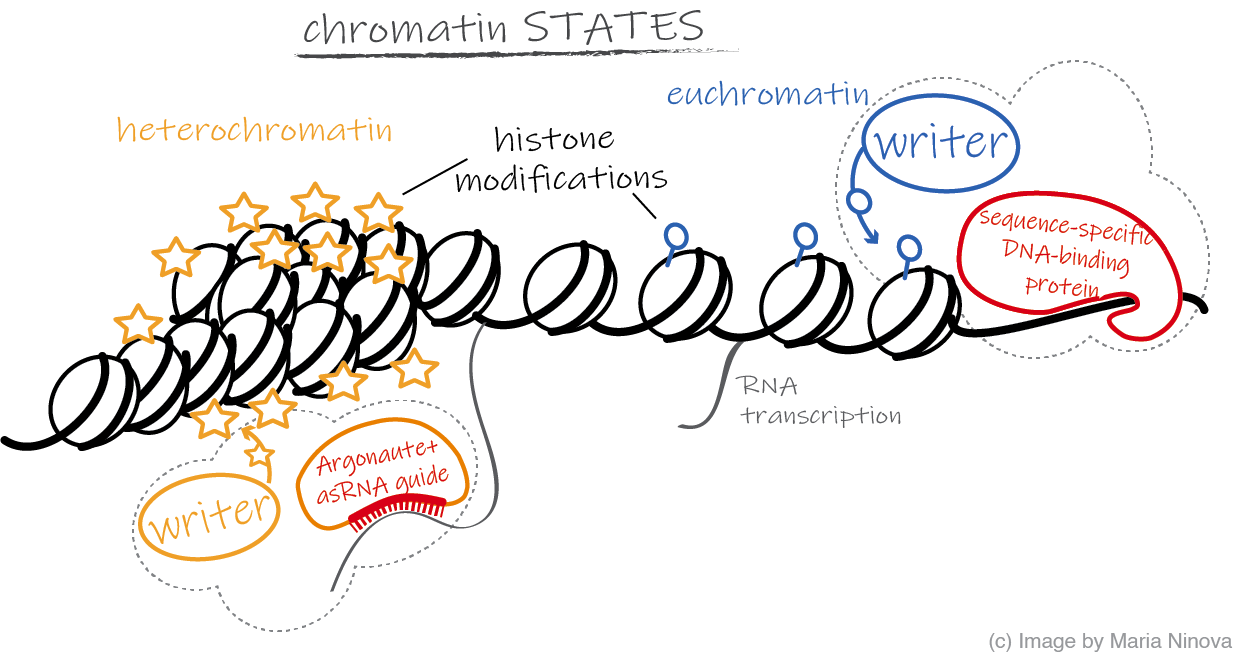 Post-translational histone modifications can alter chromatin density thereby modulating the accessibility for transcription, and recruit various downstream regulatory and structural factors. In principle, targeting specific modifications to appropriate regions tin can be achieved via dissimilar mechanisms involving Deoxyribonucleic acid-binding proteins or non-coding RNAs that recruit enzymatic "writers". In one case installed, modifications can be recognized by "reader" factors with various regulatory outcomes, and as well removed by "eraser" enzymes. Yet, we lack detailed understanding of the regulation of unlike chromatin states. Our lab is interested in central aspects of chromatin regulation such as:
- What are the mechanisms that identify specific genomic regions for modification?
- How are different chromatin regions kickoff defined during embryogenesis and then maintained during mitotic divisions?
- What are the biological functions of different histone marks?
We address these questions past a combiation of molecular biology, imaging, genomics (RNA-seq, ChIP-seq), and proteomics approaches. Most of our projects utilize the Drosophila melanogaster model organization, which laid the foundations of modernistic genetics and has been at the borderland of chromatin, piRNA (see below), and transposon inquiry. Areas of specific interest include:
The mechanism of piRNA-mediated silencing
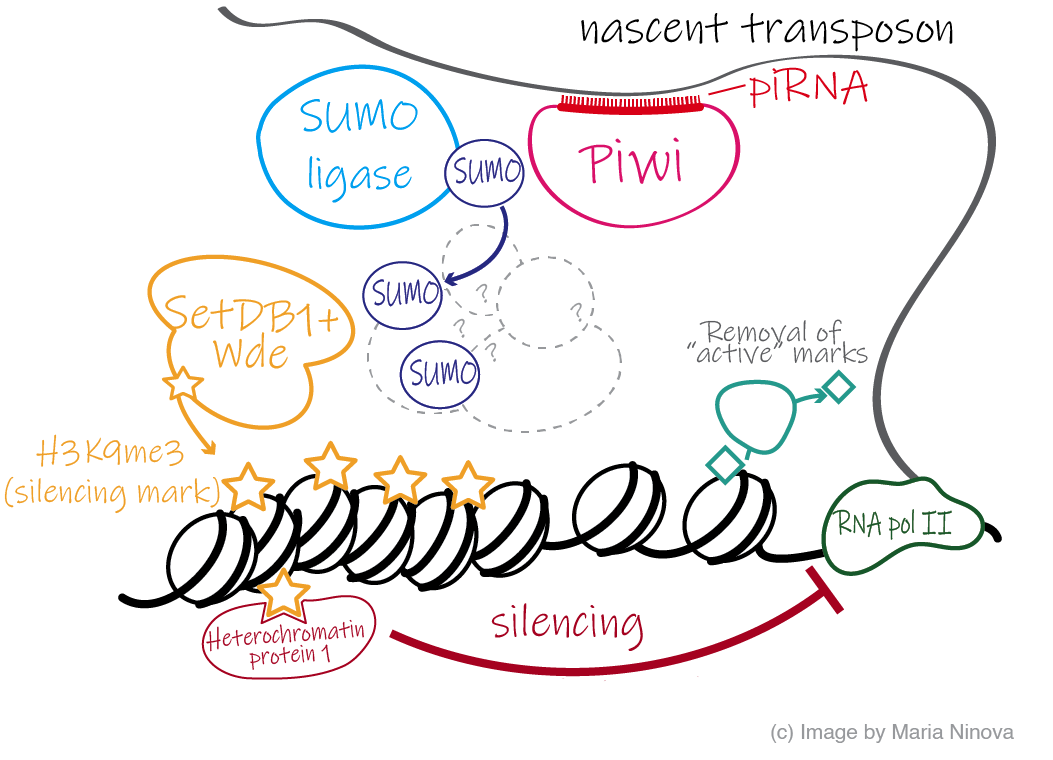 piRNAs are a class of short non-coding RNAs produced in the germline and some somatic tissues of animals that associate with Argonaute proteins from the Piwi clade, and office to recognize and silence transposons - "jumping genes" that can otherwise harm Dna. Defects in the piRNA pathways lead to transposon activation, defects in gametogenesis, and sterility. Remarkably, specific piRNA-loaded Piwi-due south have the ability to enter the nucleus and induce transcriptional silencing of transposons by recruiting repressive chromatin-modifying factors - a smashing example of non-coding RNAs triggering epigenetic modifications in beast systems. Contempo studies identified several new factors essential for Piwi function. For example, it recently emerged that the SUMO (Small Ubiquitin-Like Modifier) pathway is required for transposon silencing and repessive chromatin formation at piRNA targets. All the same, the precise mechanism by which piRNA/Piwi complexes recruit the silencing effectors is not well understood. Our lab aims to utilize a combination of molecular biological science, genomics, and proteomics strategies, to dissect the procedure of piRNA-mediated silencing.
Regulation of gene expression by H3K9me3
Heterochromatin was historically identified as the nighttime staining portion of interphase chromatin which remains condensed and is typically (but not e'er) transcriptionally silenced. Heterochromatin is essnetial for many aspects of prison cell function and development, such equally dosage bounty, lineage-specific gene silencing during differentiation, maintaining the integrity of the repetitive chromosome ends, and repression of transposons. Histone 3 lysine 9 trimethylation (H3K9me3) is a highly conserved hallmark of silencing and heterochromatin that occupies a substantial portion of the eukaryotic genomes and is implicated in the compaction of echo-rich sequences nearly centromeres and telomeres, and transposon repreression. In addition, this mark is found on dozens of host genes and regulatory regions outside constitutive heterochromatin, and appears to play a role in gene regulation and cell specification. Our lab is interested in gaining a deeper agreement of the biological function of H3K9me3 in different cellular and genomic contexts.
Developmental regulation of heterochromatin
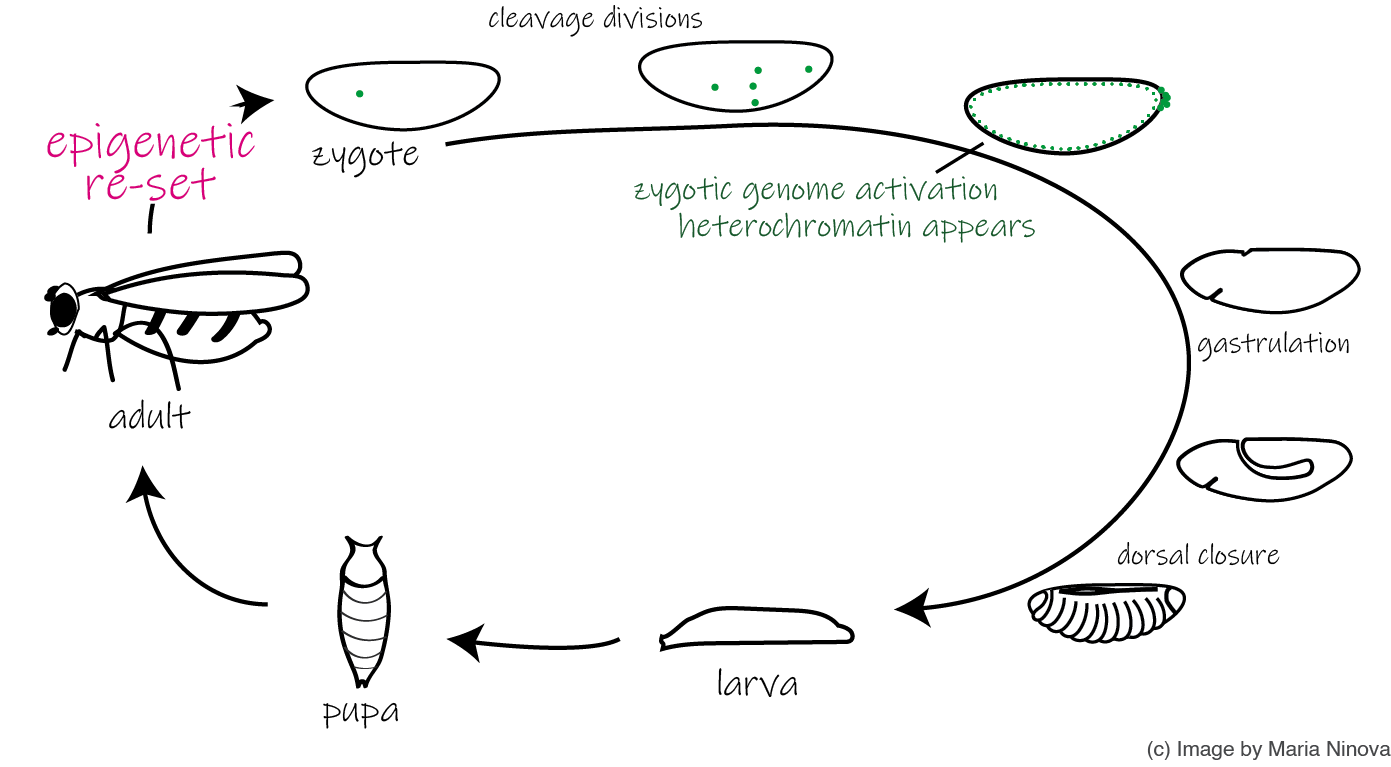
The vast majority of histone and Deoxyribonucleic acid modifications are erased during gametogenesis and fertilization, and need to be re-established de novo in a cell-specific mode during the development of the new organism. We are interested in the factors and molecular mechanisms that orchestrate the initiation and maintainance of heterochromatin from the zygote throughout embryogenesis using the fruit fly embryo system as a paradigm.
Principal Investigator
Team



Kun Wu
PhD Rotation Pupil BCMB
Open up positions
I am looking for motivated individuals at different career levels interested in the lab's scientific areas to join my inquiry team. Available projects employ a variety of archetype and state-of-the-art approaches, and provide the opportunity to obtain training in either or both experimental biological science and bioinformatics. PhD and postdoc positions are open to both U.s.a. and international (subject to U.South. visa rules) applicants. Women and underrepresented minorities are encouraged to apply!
Contact me direct with whatsoever further questions and to utilise. Please include a short paragraph describing your scientific interests and motivations, resume/CV, contacts of three referees, and if bachelor - an example publication (preprint is fine) reflecting prior work.
Postdocs
Applicants should be near completion or take completed a PhD plan in the following or related disciplines: molecular biology, biochemistry, biophysics, genetics, bioinformatics, and have either substantial hands-on experience with standard biochemistry and molecular biology techniques (such as PCR, Western blotting, protein purification, cloning, etc.), and jail cell civilisation, or experience in computational analysis of sequencing data and comparative genomics. Experience with Drosophila is a plus, but is not required. We are particularly interested in individuals with stiff background in biochemistry and proteomics for a NIH-funded postdoctoral position.
Graduate (PhD) students
Applicants must be admitted to i a graduate programme at UC Riverside, preferably:
- Biochemistry and Molecular Biology
- Cell, Molecular and Developmental Biology
- Genetics, Genomics and Bioinformatics
Information regarding eligibility criteria, application deadlines (usually in the fall), and awarding process is bachelor on each plan'due south website. Many of the projects will involve next generation sequencing (e.k. RNA-seq, ChIP-seq), and are particularly suitable for individuals who wish to obtain a "mixed" preparation in biology and bioinformatics. It is not necessary to have prior programming experience, however, groundwork in a biology-related discipline is helpful. Prospective students interested in rotating in or joining the lab are encouraged to get in touch on with Maria in advance to discuss research opportunities. Co-mentoring arrangements jointly with other PIs are also a possibility.
Laboratory Administration/Specialists
We welcome applications for junior staff positions (laboratory banana or junior specialist) from individuals interested in taking part in our inquiry. Candidates should have at least a bachelor's degree or equivalent in life sciences and take some prior lab experience. These positions are ideal for recent graduates seeking to gain actress enquiry feel. For inquiries, contact Maria and include [TECHNICIAN] (with the brackets and upper case letters) in the subject line.
Undergraduates
Undergraduate pupil research opportunities will get available in the winter quarter. Students interested in the lab research areas should contact Maria to discuss potential projects and timelines. Delight include [UNDERGRAD] (with brackets and upper case) in the subject line.
Contact
About UCR
The University of California, Riverside (UCR) is 1 of the campuses of the Academy of California system. Hosting over twenty,000 undergraduate and 3,000 graduate students, UC Riverside prides itself on existence ane of America's fastest rising and about various Universities.
The UCR campus is located in the Urban center of Riverside, function of the Greater Los Angeles metropolitan expanse. One of the sunniest Us cities, Riverside location provides a rare combination of small-town feel and proximity to great natural and urban areas: within virtually one hour drive (~50 miles) from the Pacific Bounding main and popular beaches such as Huntington Beach, mountains (e.grand. the Big Bear Lake and Ski Resort in the San Bernardino Mountains), downtown LA and Hollywood. It is also about i.5-two hours away from Joshua Tree National park, the Santa Monica and Malibu Recreation Areas, the San Diego metropolitan expanse, and numerous attractions including Disneyland, SeaWorld, Universal Studios, SixFlags, the Getty Museum.
Please cheque out the UCR website for more information about our campus, customs, and student life.
Source: https://www.ninovalab.org/

Posting Komentar untuk "Do I Have to Take Lab Portion Again Ucr"