Review of the Prodigal God Discussion by Tim Keller
A review of The Prodigal God
In The Prodigal God (2010), Timothy Keller proposes to 'lay out the essentials of the Christian message, the gospel' and 'to get to the heart of the Christian faith'.[one] The book 'is non just for seekers', but for lifelong believers who think they understand the basics of the Christian faith. Merely Keller thinks, '1 of the signs they you may not grasp the unique radical nature of the gospel is that  you are certain that you lot practice'.[two] Toward this end, Keller interprets the Parable of the Prodigal Son (Luke 15:11-32) wherein he claims to take unlocked 'the truthful meaning of it', and to take 'discovered the secret center of Christianity'.[3] He says that 'Jesus is showing u.s.a. the God of Great Expenditure… God'due south reckless grace is our greatest hope.'[4]
Having accepted the psychological premise that nosotros are all seeking 'personal significance and worth'[5], Keller finds the 'true meaning' of the Parable to be 'two bones means people attempt to discover happiness and fulfilment'.[vi] Elder brothers follow the way of 'moral conformity' and younger brothers 'the fashion of self-discovery'. The younger son is on a quest for 'self-actualization',[7] he is 'the i who connects with Jesus'.[viii] In stark contrast, the elder brother is the 'moral insider… blind, narrow, and self-righteous'.[9] Nowhere in the book does Keller give a clear caption of the Gospel, the mode of conservancy.
Keller says the target of Jesus' Parable is 'not wayward sinners but religious people who do everything the Bible requires'.[x] One of his aims is to explicate why churches are often and so unpleasant. He writes: 'I accept explained in this book why churches—and all religious institutions—are oft so unpleasant. They are filled with elder brothers…'[11] The reader is left in no doubt that religious people, those who seek to obey Scripture, are the real target of Keller's volume.
The younger brother
The younger son is described equally 'a free spirit',[12] who is weary of the human relationship with his father.[13] Having received his inheritance, he goes off to a far state and squanders everything through a wayward lifestyle, and 'when he is literally down in the mud with the pigs, he "comes to his senses" and devises a plan'.[xiv] Keller tells usa that the younger son had worked out a business concern plan for repaying his father the debt.[fifteen] But Scripture says nothing well-nigh a business organisation plan, merely that the rebellious younger son had made up his listen to confess his sin to his father. 'I volition ascend and become to my father, and will say to him, "Father, I have sinned confronting heaven and before you, and am no more worthy to be chosen thy son: make me as i of thy hired servants." ' (Luke fifteen.xviii-19).
On his way abode the younger son is surprised to encounter his father running to meet him. 'Flummoxed, he tries to roll out his business plan for the restitution. The father interrupts him, not only ignoring his apposite voice communication, only straight contradicting it.'[xvi] In Keller's account, reverse to Scripture, the father does non give the younger son a risk to confess his sin or express his repentance. The father says: 'I'chiliad not going to wait until you've paid off your debt; I'grand not going to expect until you've duly grovelled. You lot are not going to earn your way back into the family unit, I am going to only have you dorsum.'[17]
So Keller sees repentance as grovelling, which he regards as unnecessary and demeaning. Keller presents the motion picture of a begetter who simply takes the son back. No mention of sin, no mention of confession, no need for repentance. Keller expresses it like this: 'God'due south honey and forgiveness can pardon and restore any and every kind of sin or wrongdoing.'[18] Keller's portrayal of what he calls 'the freeness of God's grace'[19] is really describing what German theologian Dietrich Bonhoeffer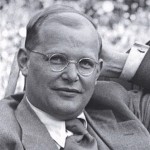 called 'cheap grace'. In his book The Cost of Discipleship (1937) Bonhoeffer explains the distinction between 'inexpensive' and 'costly' grace. He writes: 'cheap grace is the preaching of forgiveness without requiring repentance… Of course you have sinned, merely now everything is forgiven, then you can stay as you are and enjoy the consolations of forgiveness…' In contrast, 'plush grace confronts us every bit a gracious call to follow Jesus, it comes as a discussion of forgiveness to the broken spirit and the contrite heart…'
The elder brother
Keller'south main focus is the elderberry blood brother every bit he continues to add to Scripture. He describes elderberry brothers as the 'bourgeois', those who seek 'legitimacy through an ethic of hard piece of work and moral rectitude'.[twenty] He claims that the 'perceived bourgeois hypocrisy' of elder brothers leads to the bohemian behaviour of younger brothers, like 'the Bloomsbury Grouping of London, the Beats of Greenwich Village, and the indie-rock scenes of today'.[21]
He says the elder brother 'disgraced the father' publicly past forcing him 'to come out to speak'.[22] So comes the 'denouement'. Keller puts these words in the male parent's oral cavity: 'My son, despite how you lot've insulted me publicly, I nevertheless want you in the feast. I am non going to disown your brother, but I don't want to disown you either…'[23] Keller provides his interpretation: 'Jesus is redefining everything we thought nosotros knew about connecting to God. He is redefining sin, what information technology ways to be lost, and what information technology ways to be saved'.[24]
The Pharisees
Keller says that the Pharisees were represented in the Parable 'by the elder brother. They held to the traditional morality of their upbringing. They studied and obeyed the Scripture. They worshiped faithfully and constantly.'[25] They are the religious people 'who exercise everything the Bible requires'.[26] Here we see a fault-line in Keller'south theology. The Pharisees were non people who believed and obey the Bible, as Keller asserts. On the contrary, the Pharisees held to the tradition of men. Our Lord said to the Pharisees, 'For laying bated the commandment of God, ye agree the tradition of men, every bit the washing of pots and cups: and many other such like things ye practise' (Mark 7.xiii). The Pharisees feigned obedience to God'south Word, simply they did non really obey it—they were hypocrites who did non obey God's moral law, they only kept the formalism rites, like manus washing. Jesus called them hypocrites vii times in Matthew 23.
And here Keller introduces a remarkable paradox. He says that the instruction of Jesus 'consistently attracted the irreligious while offending the Bible assertive religious people of his day'.[27] Keller is telling united states of america that Bible believing people were offended by the educational activity of Jesus. But that cannot be true, for all Scripture speaks of Jesus Christ (Luke 24.27), so Bible believing people see Christ in the Scriptures, and are non offended by the didactics of Jesus.
Keller asserts that, 'The elder brother in the parable illustrates the fashion of moral conformity. The Pharisees of Jesus' day believed that, while they were a people chosen by God, they could only maintain their identify in his blessing and receive final salvation through strict obedience to the Bible.'[28] But the Pharisees did non strictly obey the Bible. It is remarkable that a theologian of Keller's continuing can make such a fake statement. As we take already seen, the Pharisees were hypocrites, who followed the tradition of men and did non obey God'due south moral constabulary.
Fanatical Christians
Keller is certain that 'the real audition for this story is the Pharisees, the elder brothers'.[29] Keller's purpose appears to be to convince his readers that Bible believing Christians, who seek to obey God's moral law, are really elder brothers, merely like the Pharisees. This is reminiscent of his stereotype of 'built-in-again Christians' in The Reason for God (2008). In that location Keller labels 'born once more' Christians as fanatics. 'Many not-believers take friends or relatives who have go "born once more" and seem to take gone off the deep finish. They soon begin to express loudly their disapproval of various groups and sectors of our society – especially movies and television, the Democratic Party, homosexuals, evolutionists, activist judges… When arguing for the truth of their faith they frequently appear intolerant and self-righteous. This is what many people would call fanaticism.'[30]
Keller then makes his argument. 'Call up of people you consider fanatical. They're overbearing, self-righteous, opinionated, insensitive and harsh. Why? It's not because they are as well Christian simply because they are not Christian enough. They are fanatically zealous and courageous, but they are non fanatically humble, sensitive, loving, compassionate, forgiving or understanding – as Christ was.'[31] Keller has clearly forgotten Christ'southward encounter with the unbelieving Jews. In John chapter 8, Jesus said to them: 'Yous are of your father the devil, and the desires of your father you lot desire to exercise' (John viii.44).
Keller characterizes 'built-in over again' Christians equally harsh, insensitive, self-righteous and intolerant, people who loudly expresses views on politics, homosexuality and development. The very tolerant Keller is completely intolerant of born again Christians such equally C. T. Studd who left Cambridge University to spend his life as a missionary in Africa saying, 'Real Christians will always be chosen fanatics'.
Keller's political agenda
Keller now enlarges on the 'desperate spiritual status' of the elderberry brother.[32] We are told that 'elderberry brother'south self-righteousness not only creates racism and classism, only at the personal level creates an unforgiving, judgmental spirit.'[33] He uses his flawed analysis of the Parable to promote his political agenda. He writes: 'When we see the mental attitude of the elderberry brother in the story we brainstorm to realise one of the reasons the younger brother wanted to leave in the first identify… They have come up to the conclusion that religion is 1 of the greatest sources of misery and strife in the world.'[34] Keller continues: 'And judge what? Jesus says through this parable—they are right… The acrimony and superiority of elder brothers… can create a huge body of guilt-ridden, fear-ridden, spiritually blind people, which is one of the groovy sources of social injustice, state of war, and violence… Our big cities are filled with younger brothers who fled from churches in the heartland that were dominated past elder brothers.'[35]
Keller tells of the many young adults who come up from more conservative parts of the Us to study in New York. 'Here they meet the kind of person they had been warned virtually for years, those with liberal views on sex activity, politics, and civilisation. Despite what they had been led to believe, those people were kind, reasonable, and open up-hearted.'[36]
Keller argues that 'elder blood brother types' (conservative Christians), who come from the more conservative parts of the Usa, at a personal level are hostile bigots with an unforgiving and judgmental spirit. At a political level they are the crusade of racism, classism, social injustice, war and violence. On the other manus, Keller says those with liberal views on sexual activity, politics, and culture, are kind, reasonable, and open-hearted. So the reader is asked to believe that conservative Christians are hostile bigots, while unbelieving liberals are kind and open up-hearted. What a travesty of the truth.
Another flaw in Keller'southward theology is that he fails to distinguish Pharisees from true believers who are 'zealous for expert works' (Titus two:14) having been 'created in Christ Jesus to do good works, which God prepared in advance' considering they are 'God's workmanship' (Ephesians 2:10). Reverse to Keller'south view of the Pharisees as those who obey the Bible, Scripture presents the Pharisees equally those who hold to the tradition of men and exercise non go along God's police force. The outset Christian martyr Stephen, in his defence before the leaders of State of israel, said: 'You stiff-necked and uncircumcised in heart and ears… who have received the law past the direction of angels and accept not kept information technology' (Acts 7.51-53).
Yet Keller's church, we are informed, has been able to make a 'clear distinction between the gospel and religious moralism… there is a mode to know God that doesn't pb to the pathologies of moralism and religiosity'.[37] What Keller actually means is that he has created a loving and non-judgemental brand of Christianity that does not stand confronting liberal view on sex, politics and culture; a brand of Christianity that does non practice strict obedience to God's moral constabulary. But this is counterfeit Christianity.
The Psychological Gospel
Throughout The Prodigal God, Keller relies on psychoanalytic theory to describe and explain the deportment of the younger and the elderberry brother. Younger brothers 'pursue their own goals and self-actualization regardless of custom and convention'.[38] Elder brothers seek happiness 'by achieving moral rectitude'.[39] They 'base their self image on being hardworking or moral… this inevitably leads to feeling superior'.[40] Keller concludes: 'Underneath the brothers sharply different patterns of behavior is the same motivation and aim.'[41] Keller imagines he tin can read the centre of human being and understand it via psychoanalytic constructs. He really says that 'elder brothers obey God to become things'. And, 'elder brothers are being moral but for their ain benefit'.[42] How does he know this? And more: 'If, similar the elder brother, you seek to control God through your obedience, then all your morality is just a fashion to use God to make him give you the things in life you really desire.' How does he know what is in the heart of those who obey God? Keller shows his ignorance, for our Lord said, 'He who has my commandments and keeps them, it is he who loves me' (John fourteen.21). According to Scripture, those who obey God'south commandments are those who love God (1 John 5.iii). After pages of psychoanalysis, the reader is left with diagnosis and treatment rather than any understanding of sin and conservancy.
Redefining sin
Keller'due south flawed approach lends support to his redefinition and deconstruction of sin, redemption and the very nature of God. Very much in keeping with the traditions of men and today'south counseling movements, The Dissipated God is filled with the author's judgments of people's hearts (motivations). In contrast to Scripture, the problem of Keller's younger brothers is never inside; Scripture states conspicuously that homo'south problem is not ecology but is rather a problem of the heart (Marker 7:17-23). Post-obit the tradition of men, Keller places the problem exterior of man. He asserts that the mental attitude of the elder brother was 1 of the reasons the younger brother wanted to leave home.[43] He fifty-fifty says that the elder brother'due south self-righteousness causes racism and classism.[44]
The True Elderberry Brother
As noted to a higher place, Keller much embellishes the story of the father in the Parable. Afterward describing both the 'cocky-discovering' younger son and the 'moralistic' elder blood brother, he then introduces his own version of Christ equally 'the true elder brother', whom we 'need to escape the shackles of our particular brand of lostness…'[45] In developing this concept Keller says, 'the start affair nosotros demand is God's initiating love'.[46] This beloved Keller describes every bit lavish, prodigal and admittedly free.[47] Nowhere does he acknowledge the wrath of God upon sin, nor does he mention that human should fright the wrath and judgment of God. To Keller, 'to truly become Christians we must also apologize of the reasons we ever did anything right… Christians repent for the very roots of their righteousness, likewise.'[48] He continually emphasizes a psychological construct of sin and salvation request, 'How can the inner workings of the heart be changed from a dynamic of fright and anger to that of love, joy, and gratitude?'[49] Keller assures the reader that 'honesty born of fear does aught to root out the central crusade of evil in the world…'[50] Scripture disagrees with Keller's analysis. 'And now, State of israel, what does the Lord your God require of you, but to fearfulness the Lord your God, to walk in all His ways and to love Him…' (Deuteronomy 10: 12). Those who fear the Lord are describes equally God'south treasured possession (Malachi 3: 16, 17).
Every bit is e'er the instance when human being is portrayed as a victim of circumstance rather than a rebel confronting his Creator, the Cross becomes quite irrelevant. In keeping with this, Keller describes the human being race equally 'a ring of exiles trying to come home'.[51] Scripture describes fallen man is as those who continue to run and hide. 'There is none who seeks afterwards God' (Romans 3.11). Keller says, 'When we encounter the beauty of what he has done for us, it attracts our hearts to him… to the degree nosotros see his beauty we will be free from the fearfulness and neediness that creates either younger brothers or elder brothers.'[52]
Iv Ways
In the closing affiliate of The Prodigal God, Keller asks, 'How will our lives change as we alive them based on Jesus' message virtually sin, grace and hope?'[53] He reminds us that Jesus 'left a meal—what we today telephone call the Lord's Supper or Eucharist—as a sign of his saving grace. And of course, Jesus' parable of the lost sons ends in a party-feast that represents the corking festival of God at the end of history.'[54] Here we should note that he equates the Protestant ordinance of the Lord's Supper with the Eucharist of the Roman Catholic Church, which is based on the Real Presence or transubstantiation. He then outlines four ways to bask such a feast.
Beginning, Keller says, 'Jesus came to bring festival joy'.[55] He follows that with, 'If y'all are filled with shame and guilt, you do not merely demand to believe in the abstract concept of God's mercy. You must sense, on the palate of your middle, every bit it were, the sweet of his mercy. And then you will know you are accepted. If you are filled with worry and anxiety, yous practice non only need to believe that God is in control of history. Y'all must see with the eyes of the heart, his dazzling majesty.'[56] Thus salvation must be a pleasant sensual feel, only 'then you will know y'all are accepted'.[57]
2nd, Keller moves from insisting that 1'south salvation must be a pleasant sensual feel to insisting that information technology must produce a pleasant material earthly kingdom as well. Thus he attempts to inform the reader as to how man can accomplish 'a radical change… in the very fabric of the material world'.[58] He says, 'the ultimate purpose of Jesus is non only private salvation and pardon for sins, but also the renewal of this world, the finish of disease, poverty, injustice, violence, suffering and death'.[59] He carefully avoids any mention of Peter'south description in which 'the globe and everything in it will be laid bare' and 'the elements will melt in the heat' (two Peter 3:10-13). Instead of Peter's sure and certain word that we are looking for 'a new heaven and a new earth', Keller points the reader to 'the renewal of this world'.[threescore]
Again, Keller diverts the readers from the Cantankerous to their own skillful works as he states emphatically, 'the inevitable sign that you know you lot are a sinner saved by sheer costly grace is a sensitive social conscience and a life poured out in deeds of service to the poor'.[61] He embellishes this with 'God hates the suffering and oppression of this material world then much, he was willing to get involved in it and to fight against it',[62] concluding that 'Christians therefore tin talk of saving the soul and of building social systems that evangelize safe streets and warm homes in the same judgement. With integrity.'[63] In his book Generous Justice (2010), he warns his readers that 'if yous are not just, you've non truly been saved by organized religion'.[64] And by this Keller is non speaking of justification only rather of and then-chosen just works.
Tertiary, Keller correctly describes salvation as 'individual', saying that 'we must personally appropriate' the Gospel 'making it more than and more than central to everything we run into think and feel'.[65] He says a repast fuels growth. 'The Lord's Supper, besides called Communion or the Eucharist, represents ongoing growth in God's grace.'[66] Keller once more shows his ecumenical ambitions as he places the Roman Catholic Eucharist alongside the Protestant Lord's Supper. He asserts that 'we must feed on the gospel, as it were, making it part of ourselves'.[67] He and then suggests that 'y'all may wish to go more generous with your money'.[68]
4th, Keller explains why churches are oftentimes so unpleasant—because they are filled with elder brothers.[69] Nevertheless, to grow spiritually Christians demand 'a deep involvement in a customs of other believers. Y'all can't live the Christian life without a band of Christian friends, without a family unit of believers in which you find a place.'[70] He adds, 'you must be deeply involved in the church, in Christian community, with strong relationships of love and accountability. Only if you are a function of a community of believers seeking to resemble, serve, and love Jesus will you lot ever get to know him and grow into his likeness.'[71] Thus Keller promotes the idea of so many comfortable Christians enjoying the social life at church. At that place is no admonition that Christians should deny them selves and take upwardly their cantankerous daily; that Christians should be prepared to suffer for the cause of Christ; that Christians are engaged in a spiritual state of war against the forces of darkness (Ephesians six).
Keller leaves his readers believing that conservancy is a pleasant sensual experience in which we restore the creation and end poverty while joined to a church involved in similar pursuits. For Keller, this is authentic Christianity.
Decision
In The Prodigal God Keller uses the image of the elderberry brother to caricature conservative Christians as judgemental, hostile bigots. In Keller's mind, the reason that conservative churches are so unpleasant is because they are filled with elder brothers (conservative Christians), who speak out against liberal, immoral values on sexual practice and politics. Keller is profoundly hostile towards conservative Christians, whom he regards as the major cause of nearly problems in the world. And then nosotros take the remarkable paradox of a leading Presbyterian theologian who is vehemently opposed to the Reformed Christian faith. Even more than amazing is the fact that he is the leader of The Gospel Coalition.
Keller redefines sin using all-as well-familiar psycho-analytic constructs like insecurity, anger, poor self-image, incapacity for attachment and suppression of feelings. Salvation is redefined equally a pleasant feel with no need for 'groveling' or fear. The Christian life is redefined equally pouring one's efforts into correction of social injustice. God is redefined as the Great Expenditure, recklessly lavishing his unconditional grace on those fatigued to his 'beauty'. Conspicuously, Keller offers a Christianity in which 'everyone is loved, and anybody is called to recognize this and change'.[72] Enjoy the feast, no questions asked, no cost to be paid.
Surely information technology is a modern-day Pharisee who would teach the doctrines of men and term it 'recovering the middle of the Christian faith'.
YYou can acquire more nigh Dr Tim Keller, Pastor Marker Driscoll and Pastor John Piper in the book, The New Calvinists (2014), published by The Wakeman Trust and Belmont House Publishing. The book is available from The Metropolitan Tabernacle bookshop or from Amazon More on John Piper and his Christian Hedonism at The Existent John Piper website
[i] Tim Keller, The Prodigal God, Hodder & Stoughton, 2010, ppxi and xii
[2] Ibid. pxi
[iii] Ibid. pxiii
[four] Ibid. pxv
[v] Ibid. p29
[6] Ibid. p29
[seven] Ibid. p30
[8] Ibid. p15
[9] Ibid. p10
[ten] Ibid. p10
[11] Ibid. p125
[12] Ibid. p11
[13] Ibid. p18
[14] Ibid. p20
[xv] Ibid. p21
[16] Ibid. p22
[17] Ibid. p23
[18] Ibid. p24
[19] Ibid. p25
[20] Ibid. p12
[21] Ibid. p12
[22] Ibid. pp25-26
[23] Ibid. p27
[24] Ibid. p28
[25] Ibid. p8
[26] Ibid. p10
[27] Ibid. p15
[28] Ibid. pp29-30
[29] Ibid. p28
[30] Tim Keller, The Reason for God, Hodder & Stoughton, 2008, p56
[31] Ibid. The Prodigal God, p57
[32] Ibid. p47
[33] Ibid. p55
[34] Ibid. p66
[35] Ibid. p67
[36] Ibid. pp68-69
[37] Ibid. pp69-70
[38] Ibid. p30
[39] Ibid. p30
[40] Ibid. p53
[41] Ibid. p38
[42] Ibid.p60
[43] Ibid. pp66-67
[44] Ibid. p55
[45] Ibid. p73
[46] Ibid. p73
[47] Ibid. p24
[48] Ibid. p78
[49] Ibid. p85
[fifty] Ibid. p60
[51] Ibid.p97
[52] Ibid. p88-89
[53] Ibid. p105
[54] Ibid. pp105-106
[55] Ibid. p107
[56] Ibid. p108
[57] Ibid. p108
[58] Ibid. p100
[59] Ibid. p110
[threescore] Ibid. p110
[61] Ibid. p112
[62] Ibid. p113
[63] Ibid. p112
[64] Tim Keller, Generous Justice, p99
[65] Ibid. The Prodigal God, p114
[66] Ibid. p113
[67] Ibid.p115
[68] Ibid. p115
[69] Ibid. p125
[lxx] Ibid. p125
[71] Ibid. p127
[72] Ibid. p45
Source: https://www.newcalvinist.com/the-prodigal-god/

Posting Komentar untuk "Review of the Prodigal God Discussion by Tim Keller"